A case study on real-time diesel flow and consumption monitoring in a food processing facility, enabling shift-wise, boiler-wise visibility, improved fuel accountability, and accurate consumption analytics.
The Challenge
Before implementation, diesel monitoring was largely manual and fragmented. Fuel decanting from storage tanks was recorded periodically, while actual consumption by boilers was estimated based on runtime or operator inputs. This approach introduced several challenges. There was no real-time visibility into how much diesel was being decanted versus how much was actually consumed. Shift-wise consumption comparison was difficult, and discrepancies between day and night shifts often went unnoticed. Management had no clear breakdown of diesel usage by individual boilers, making it hard to identify inefficiencies or abnormal consumption patterns. Additionally, daily and monthly consumption analysis required manual consolidation of data from multiple sources, leading to delays, errors, and lack of confidence in reports. Any sudden spike in diesel usage could only be identified after the fact, resulting in delayed corrective action.
Our Solution
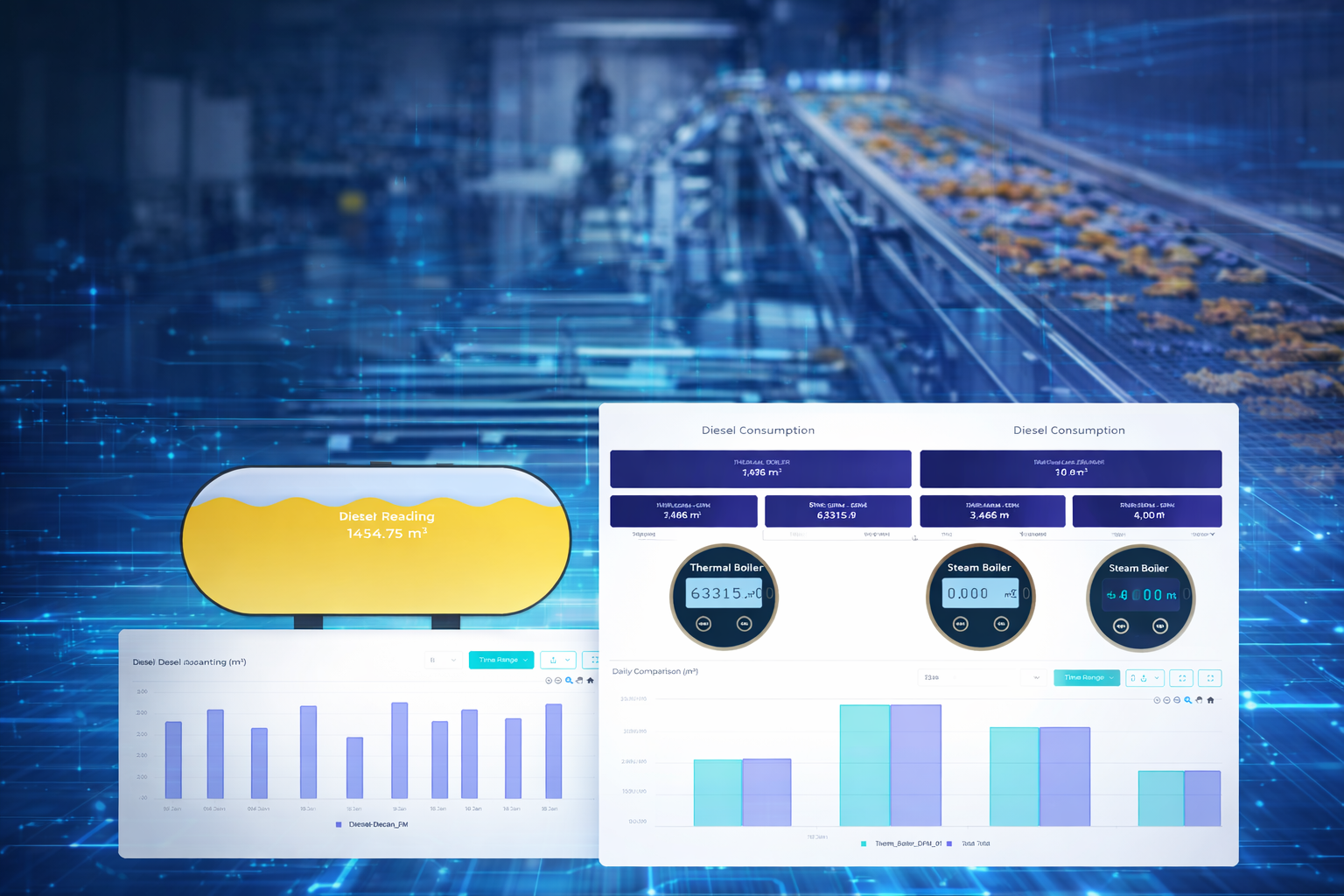
A centralized diesel flow monitoring and consumption analytics system was implemented across the facility. High-accuracy flow meters were integrated at critical points, including diesel decanting lines and boiler feed lines, and connected to a web-based monitoring platform. The solution provided real-time visibility into diesel decanting volumes, cumulative meter readings, and live consumption data. Consumption was clearly segregated between thermal boilers and steam boilers, allowing precise equipment-level analysis. Shift-wise monitoring enabled comparison between day and night shifts, helping identify operational variations. Interactive dashboards displayed total diesel consumption for selected time ranges, daily comparisons, and historical trends. Automated charts and KPIs eliminated manual calculations and enabled instant insights into fuel usage behavior. The system also ensured that all diesel-related data was securely logged and available for audits and management reviews.
Key Results
The implementation delivered measurable improvements across operations, efficiency, and cost reduction:
After implementation, the facility achieved complete transparency in diesel usage. Management could instantly correlate diesel decanting with actual consumption, significantly reducing ambiguity and manual intervention. Shift-wise and boiler-wise visibility helped identify abnormal consumption patterns and operational inefficiencies early.
Fuel accountability improved across teams, as data was now objective, real-time, and tamper-proof. Daily and monthly diesel reports were generated automatically, saving significant time and improving accuracy. The ability to compare consumption trends enabled better planning, tighter cost control, and informed decision-making.
Overall, the solution helped the client move from estimated diesel usage to precise, data-driven fuel management, reducing losses and improving operational discipline.
By digitizing diesel flow and consumption monitoring, the food processing facility gained full control over one of its most critical operational resources. The real-time monitoring platform transformed diesel management from a reactive, manual process into a transparent and measurable system, supporting cost optimization, operational efficiency, and long-term sustainability.